Dropped Domains: How to Find and Capture Expired Domains
✔️ Dropped domains are expired domains that eventually return to the open market, but the exact timeline depends on the registrar, registry, and TLD.
✔️ A good dropped domain can offer branding, historical backlinks, and residual traffic, but it is not an automatic SEO shortcut.
✔️ Before buying, review the domain's history, backlink profile, and indexing status. Google's site: operator can help, but it is not a complete indexing check.
✔️ Keyword-heavy domains and newer TLDs can still be useful, but Google does not give them a built-in ranking advantage just for the name alone.
✔️ Dynadot users can pursue expiring names through Expired Auctions and pending-delete backorders, though drop-catching is competitive and never guaranteed.
In a world where many of the best domain names are already registered, finding an original, unclaimed name can be frustrating. But domains do not stay in one state forever. They follow a lifecycle, and many valuable names eventually expire and return to the market as dropped domains. For businesses, domain investors, and personal site owners alike, the domain name aftermarket opens the door to opportunities you would never find through standard registration alone.
Starting an online presence from scratch takes time. If a dropped domain has a clean history, relevant backlinks, or some existing awareness, it may give you a useful head start. That said, not every expired domain is a good one. The key is knowing where dropped domains fit in the domain lifecycle and how to evaluate them carefully before you commit.
Domain Lifecycle
Before you start searching for a promising dropped domain, it helps to understand how domains typically expire.
A generic top-level domain usually moves through several post-expiration stages before becoming publicly available again. ICANN's standard lifecycle for many gTLDs includes expiration, a grace period, redemption, a short pending-delete phase, and then release back to the public.
ICANN also notes that some registrar-specific activity after expiration may not appear in the standard lifecycle chart, and exact timelines can vary by registrar and extension.
Source: ICANN "Domain Life Cycle"
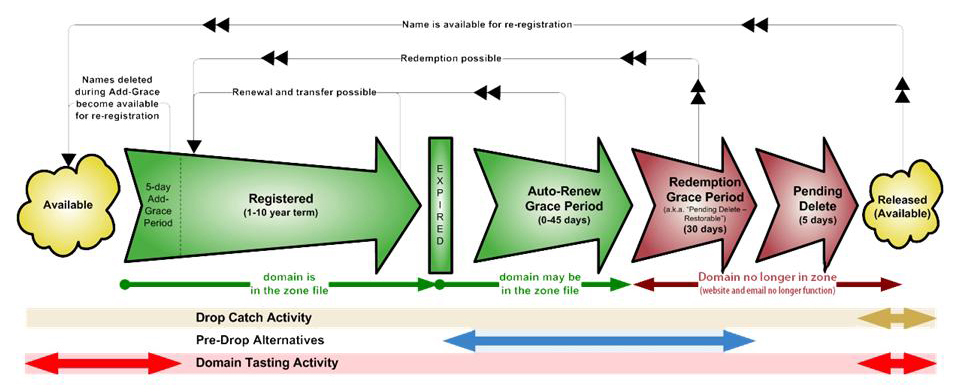
At Dynadot, many expired domains first pass through a renewal grace period, and some may then move into Expired Auctions. Depending on the TLD and auction status, a domain may later enter redemption before it is finally deleted and returned to the market.
Dynadot's current help documentation also notes that some extensions have different timelines or no grace period at all, which is why it is always smart to check the rules for the specific TLD you are targeting.
This is where dropped domains become interesting. Once a domain can no longer be renewed or restored by the previous registrant, buyers can try to capture it when it is released again. On Dynadot, that often means using the pending-delete backorder system to try to catch the name the moment it drops.
Benefits of Dropped Domains
Registering a brand-new domain gives you a clean slate, which can be a major advantage. But building authority, trust, and traffic from zero takes real time.
One of the main benefits of a dropped domain is that it may already have useful assets attached to it, such as backlinks, mentions, or direct traffic. In the best cases, that historical footprint can make a domain more appealing than a brand-new registration. However, history cuts both ways. A domain may also carry spam signals, poor-quality links, or a past association with irrelevant or questionable content.
That caution matters even more today. Google explicitly lists expired domain abuse as a spam practice when a domain is repurposed mainly to manipulate search rankings with low-value content. In other words, an expired domain can still be valuable, but only when it is used for a legitimate, people-first site rather than as a shortcut for search performance.
When you are considering a dropped domain, research is what separates a smart acquisition from an expensive mistake.
Related Article: How to Backorder a Domain Name: Complete Guide to Domain Backordering
Domain and Page Authority
What is the overall strength of the domain, and how strong are the pages that previously earned links?
Authority metrics from third-party SEO tools can still be useful as comparison points, especially when you are screening a large list of expired domains. But they should be treated as directional signals, not as proof that a domain will perform well on its own.
A better approach is to look at the quality and relevance of inbound links, whether those links were earned naturally, and whether the domain's past topic matches the project you plan to build. Google confirms that link analysis remains part of its ranking systems, but it also makes clear that domain words alone do not carry unlimited weight.
That means a dropped domain with a smaller but cleaner and more relevant link profile can be more useful than one with an inflated authority score and a messy backlink history. When in doubt, prioritize relevance, trust, and link quality over headline metrics.
Blacklist Status
Is the domain banned, deindexed, or otherwise flagged?
A quick search such as site:example.com can still be useful, but it should no longer be treated as a definitive test. Google states that the site: operator does not necessarily show every indexed URL, and results can be incomplete or somewhat random without an additional query.
If you control the website, Google says Search Console tools such as URL Inspection and the Manual Actions report are more reliable for diagnosing indexing or spam-related issues.
You can see how does the URL Inspection tool works by watching this video by Google Search Advocate Daniel Waisberg:
For domains you have not yet acquired, use a combination of checks: search visibility, archive history, backlink review, and general spam or malware screening. If the domain appears to have been used for deceptive redirects, thin affiliate pages, or unrelated content pivots, that is a strong sign to proceed carefully. Google's current spam policies make that risk especially important for expired-domain buyers.
Website History
A domain's past use is often one of the clearest indicators of whether it is worth buying.
Review historical snapshots to see how the site was used over time. Tools like the Wayback Machine can help you spot major content shifts, long periods of inactivity, or prior use cases that do not match your goals.
This is especially useful if you want a dropped domain that aligns with a particular niche, audience, or brand direction. It is also one of the easiest ways to catch domains that once hosted spam, scraped content, or material you would not want associated with your business.
The closer the domain's prior topic is to your future use, the easier it may be to build a coherent site on top of that history.
Search Volume and Existing Traffic
Does the domain contain useful keywords, and does it still attract any traffic?
A keyword-rich domain can still help with clarity and click appeal, especially when the name closely matches user intent. But it is important not to overestimate the SEO advantage. Google says domain words are just one of many relevance signals, and its exact-match domain system exists specifically to avoid giving too much credit to domains built around search queries alone.
That makes the search volume only one part of the picture. If a recently expired domain still receives direct visits, branded searches, or type-in traffic, that can be more meaningful than keyword volume by itself.
Use reliable third-party research tools to estimate traffic, then compare that with the domain's backlink profile and historical content to see whether the traffic looks legitimate and sustainable.
Domain Quality
What kind of domain is it, and does it actually fit your plans?
Depending on your goals, you may value different qualities: a short brandable name, a descriptive keyword domain, a numeric domain, or a name tied to a location or industry. Length, memorability, spelling, legal risk, and audience fit all matter.
The best dropped domain is not always the one with the strongest metrics; often, it is the one that aligns most naturally with what you want to build.
TLD choice matters here too, but mostly for branding, audience expectations, and market fit rather than for any built-in search boost. Google has said that newer gTLDs are generally treated like traditional gTLDs such as .COM and .ORG, and that keywords in a TLD do not provide an SEO advantage on their own.
Finding Dropped Domains
You can discover dropped domains through Dynadot's Expired Auctions and Backorders.
Expired Auctions are for domains that have passed their grace renewal window and moved into Dynadot's auction flow. Pending-delete backorders are different: they are attempts to catch a domain as soon as it is re-released by the registry. Dynadot makes clear that success is not guaranteed, because other registrars may also be trying to catch the same name at the same moment.
That competition is one reason high-quality dropped domains move quickly. If you are serious about acquiring one, monitor expiring inventory closely, use filters to narrow by fit and quality, and do your due diligence before placing a bid or backorder. A clean, relevant dropped domain can still be a strong asset today, but only when the domain itself and its history support the goals you have in mind.
FAQs
What is a dropped domain?
A dropped domain is a previously registered domain that expired, completed its post-expiration lifecycle, and became available again for registration or capture through the aftermarket.
Are dropped domains good for SEO?
They can be useful if they have a clean, relevant history and strong backlinks, but they are not an SEO shortcut. Google specifically treats expired-domain abuse as spam when a domain is reused mainly to manipulate rankings.
How can I check whether an expired domain is risky?
Review its backlink profile, historical snapshots, search visibility, and any signs of spammy past use. A site: search can help, but Google says it is not a complete indexing check.
Do keyword domains or newer TLDs rank better by default?
No. Google says domain keywords are only one relevance signal, and newer gTLDs are generally treated the same as other gTLDs in search.
What is the difference between an expired auction and a backorder?
An expired auction involves bidding on a domain that has entered Dynadot's auction process after expiration. A backorder is a request for Dynadot to try to catch a pending-delete domain the moment it drops.